
Process Improvement & Engineering
Engineer the way work gets done.
Find the friction, remove the waste, and build processes that scale with your business.
- Based in Oklahoma
- Serving clients nationwide
- Free 30-minute discovery call
The challenge
Most processes were never designed. They just happened.
As organizations grow, processes pile up by accident. Handoffs get missed. The same data gets entered three times. Workarounds become "the way we do it," and only one person knows how things really work.
The result is slower service, higher costs, frustrated staff and risk that is hard to see. New software rarely fixes it, because the underlying process is the problem.
Warning signs
- Work regularly waits on one person
- Customers or staff ask "where is this at?" every day
- The same errors keep coming back
- Onboarding a new employee takes months
- New software did not deliver the promised efficiency
- Your IT service desk has no consistent process
What we deliver
From messy to measurable
We draw on Lean, Six Sigma thinking and ITIL service management practices (ITIL 4 and the new ITIL Version 5), and keep the approach practical.
| Service | What it includes | What you walk away with |
|---|---|---|
| Process discovery & mapping | Workshops and interviews with the people who do the work; current-state maps | A shared picture of how work really flows |
| Bottleneck & waste analysis | Cycle time, rework, handoff and error measurement | Evidence of where time and money are lost |
| Future-state design | Simplified, standardized workflows with clear ownership and controls | A better process everyone agrees on |
| Automation roadmap | What to automate, simplify, outsource or stop | A prioritized list with expected benefits |
| IT service management (ITSM) | Service desk, incident, change, problem and asset processes based on ITIL 4 and ITIL (Version 5) | A service desk that runs predictably |
| Standard operating procedures | Step-by-step documentation, checklists and training | Consistent work and faster onboarding |
| KPIs & dashboards | Metrics and reporting that show whether the process is working | Continuous visibility |
| Change management | Communication, training and adoption support | People actually use the new process |
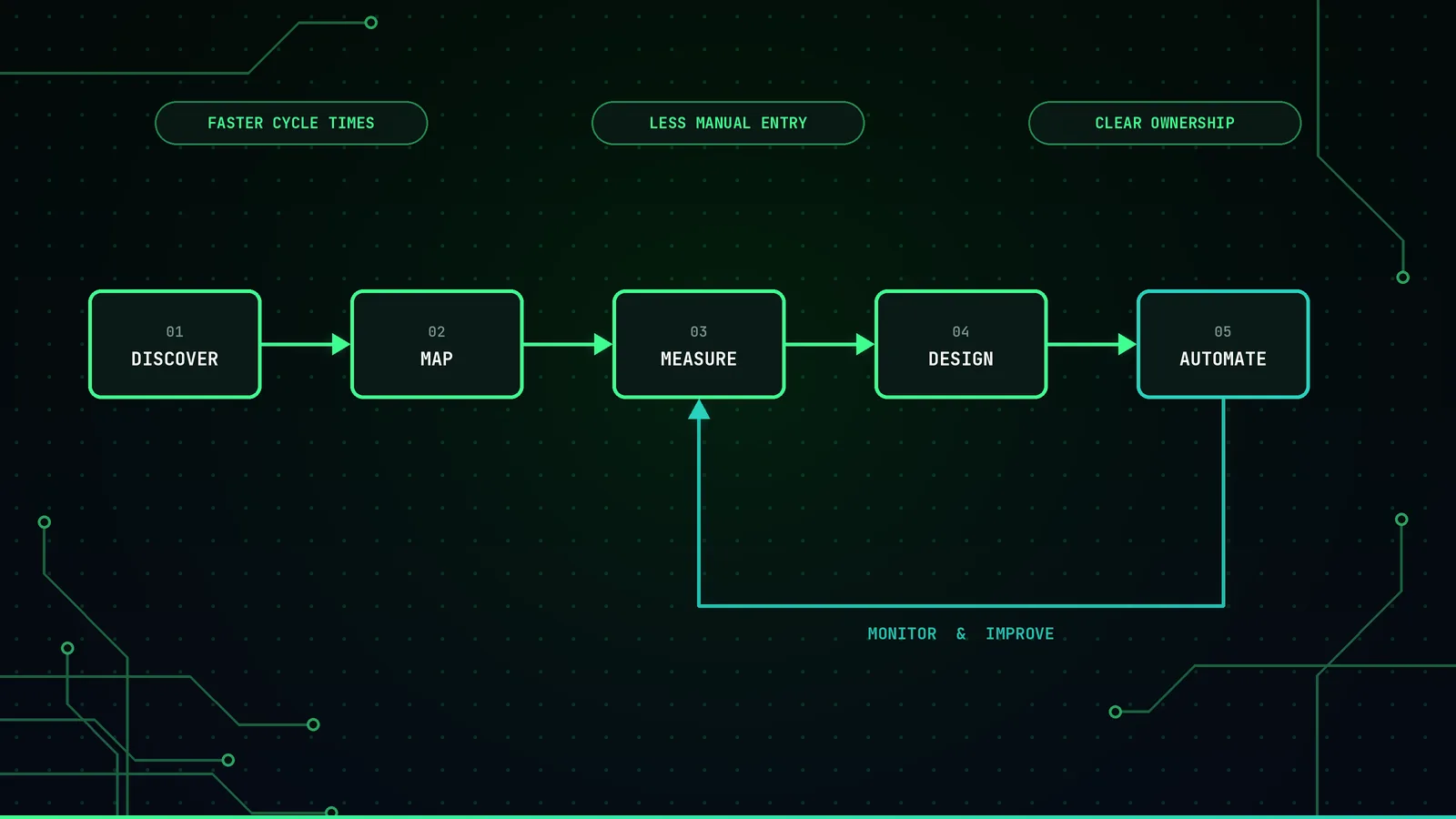
How it works
A clear path from first call to lasting results
- Week 1
Discover
Select processes, stakeholders and goals.
- Weeks 1–2
Map
Current-state mapping with the people who do the work.
- Weeks 2–3
Measure
Collect times, volumes, errors and costs.
- Weeks 3–5
Design
Future-state workflow, controls and automation options.
- Weeks 5–10
Implement
Roll out changes, procedures, training and automations.
- Ongoing
Improve
Track KPIs and keep refining.
Outcomes
Results you can measure
- Shorter cycle times for core workflows
- Less manual data entry and fewer errors
- Clear ownership and fewer dropped handoffs
- Faster onboarding with documented procedures
- Processes that are repeatable and audit-ready
Is this right for you?
A good fit if…
- Growth is exposing cracks in how work gets done
- You are about to buy or replace a major system
- Your service desk or operations team is overwhelmed
- You want to automate but are not sure where to start
FAQ
Common questions
Do you need to be on-site?
Workshops are often more effective in person, but much of the work can be done remotely.
How many processes can we tackle at once?
We recommend starting with one to three high-impact processes, then expanding.
Will this disrupt our operations?
We plan changes around your busy periods and roll them out in stages.
Do you build the automations too?
Yes. Our low-code practice can build the automations identified in the roadmap.
Next step
Let's find the hours your team is losing.
Pick one process that frustrates everyone. We will show you what a better version could look like.
Request a process assessment